
The Fourth Anniversary Of The Russian Full Scale Invasion
My Kyiv Dispatch February 24, 2022. Some thoughts

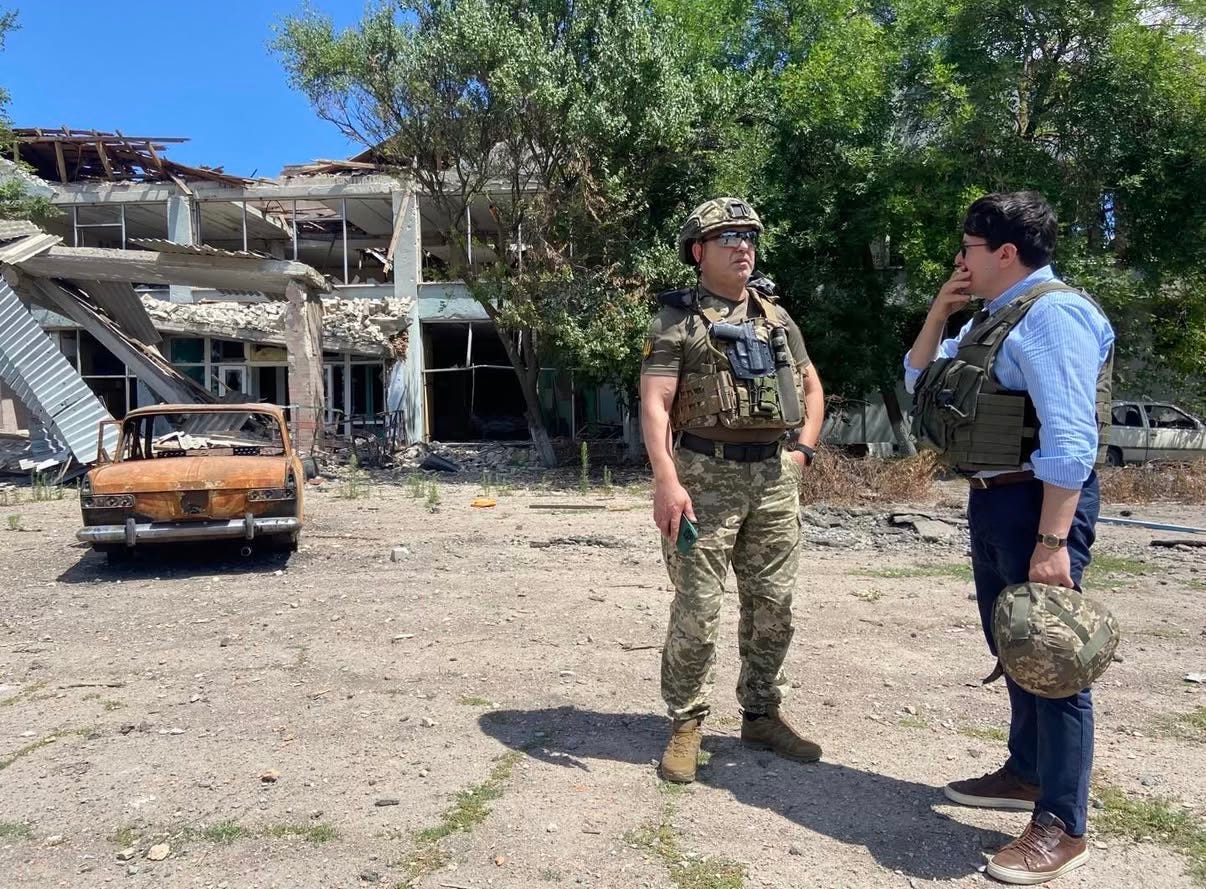
Summer 2022 - This was me reporting from a battle zone in southern Ukraine. The commanding General of the Southern Front -Major General Andrii Kovalchuk took me along on his rounds through the southern Kherson region. This was before the Ukrainian counter offensive in the south. This was my dispatch from spending a few days with the general.
Four years ago - the Russian army launched the “special military operation” which intended to bring the Ukrainian state to heel in three day days.
The Zelensky government decided to stay and fight rather than to escape to Lviv or to form a government in exile outside the country. I still retain tremendous respect for the way that Zelensky comported himself in that moment (as does the majority of the Ukrainian population despite also being well aware of his various flaws and shortcomings).
It is easy to forget in retrospect that the Russian assault plan was deadly serious and very much could have succeeded. The Russian logistical issues, lack of manpower and overestimation of their own strength as well as the fierce resistance of the Ukrainian population turned the time. Yet matters could very easily have gone the other way.
The battle of Kyiv really was a sort of providential 50/50 coin toss event.
Zelensky with his heroic composure and skillful international diplomacy likely saved the state in that first critical month.
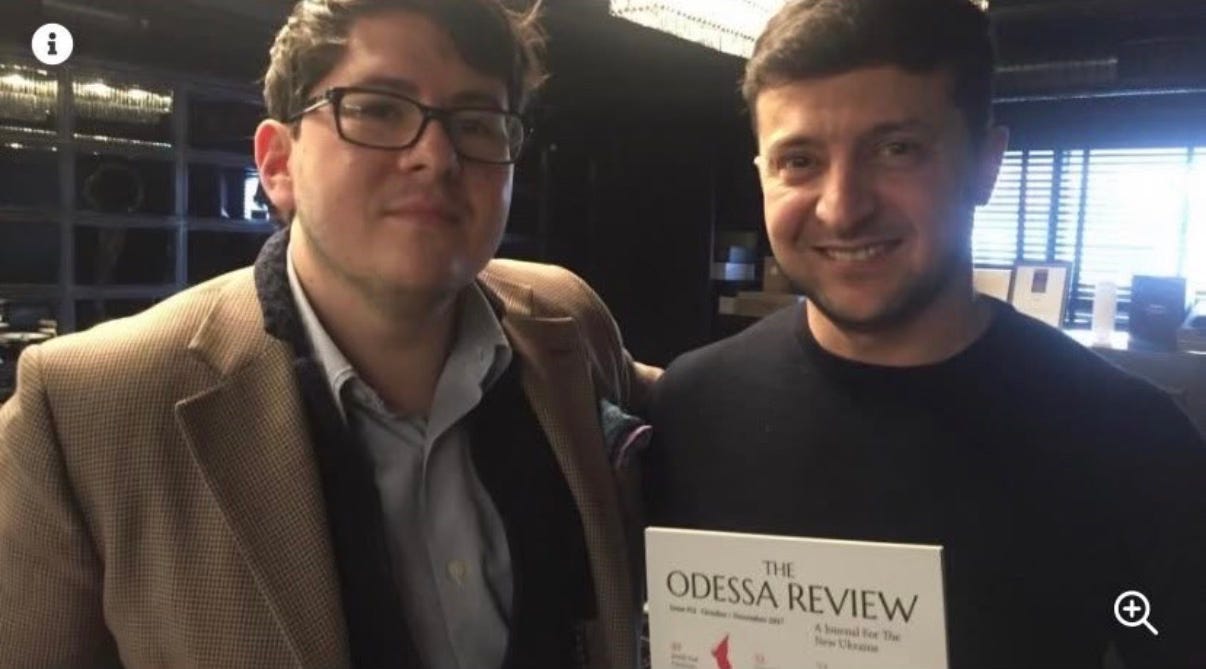
(Me and Zelensky in 2019 in Kyiv — when we were still fresh-faced young men.)
Four years later, the Ukrainian state has not been broken, with the Russians recently making only tactical gains - at utterly grotesque human cost to their troops. The negotiations which the Trump administration is backing to the hilt have been unproductive so far.
I spent the first year of the war reporting extensively all around the country.
Four years ago tonight I was called at 2 in the morning by a spy friend who told me that the location where I was staying was about to be swamped by Russian paratroopers.
I got in a taxi and left Kyiv as part of a diplomatic convoy of evacuating European diplomats. My career as a war correspondent would begin that day.
I was still a Russian citizen at the time. I had not yet burned my passport (I inherited the citizenship from my father because we lived in Moscow for two years in 1989–91 while we waited for exit visas to America). As I am a native Russian speaker and make tell-tale mistakes in Ukrainian, I assumed that I would be shot by whoever picked me up. A lot of random people were being shot at the time. The Ukrainians had opened up the armories and panicked men were running around with guns killing both real and imagined Russian saboteurs and spies. There was plenty of both. I imagined that I would be in equal trouble with the Russian troops (at a filtration camp) or with the panicked Ukrainian territorial defense guards (at a block post). A senior Azov officer would later jokingly inform me that — at his checkpoint — he would have shot me on general principle for my pronunciation of the Ukrainian “h” sound. I left Kyiv to report from the Belarus border, thinking (correctly, as it turned out) that I would be able to see the Russians from behind Ukrainian lines. I evacuated my own family a week and a half later and returned to report for the next year through the Moldovan border.
I will write more about the anniversary and the state of the war in the days to come.
This was my first dispatch of the war.
It appeared in Tablet Magazine on the 24th of February 2022.
I wrote it in the basement of a hotel in a town 40 miles from Kyiv, before moving to the south of the country.
My Last 24 Hours in Kyiv
The 24 hours leading up to Vladimir Putin’s invasion were disquieting in their combination of surrealism and tedium. The population of Kyiv was clearly deeply anxious, either engaging in seemingly over-the-top preparations for war (every cable news network reported on some little babushka learning to shoot an automatic rifle) or else ignoring it completely. Ukrainians in the capital were oblivious and stoic in the effortlessly graceful manner of men and women who have authentically embraced fatalism.
Along with my fellow Ukraine hand Nolan Peterson—a tall, avuncular, strapping, former combat pilot who is a real life version of Captain America— I wound up spending the eve of the war with the American actor Sean Penn over whiskey, vodka, and cigarettes. Penn was in good form and told us a story about meeting a young President Putin along with Jack Nicholson in a dacha near Moscow. I can confirm that hanging out with Sean Penn was also the last thing Ukrainian President Volodymyr Zelensky did before the invasion began.
My memory of that night, before war advanced ever farther into Europe, is of an utterly bored international press corps continuing to imbibe copious amounts of spirits in Kyiv’s finest dining establishments, waiting for something to happen.
For my own part, camped out in the Hyatt Hotel, I wrote in the mornings, and spent time in the banya in the afternoon. I would run on the treadmill in the basement gym and watch BBC live feeds being shot on the floor above me. Nikolay Karabinovych, my friend from Odessa and the creator of the conceptual art movement Neue Judische Kunst, called me as I was trying to sweat out the toxins from the drinking bout of the previous evening. Everyone at the time was discussing the existence of supposed “kill lists” that the Russian army was ordered to carry out against dissidents and civil society types.
Karabinovych wanted to know if I knew anything about these lists—a European diplomat had called him to say that his embassy suspected he might be on them. Given my affiliations with the Atlantic Council and Tablet, had I heard if I was also on the kill list?
“Now that you mention it,” I replied. “Probably.”
For his part, Karabinovych was delighted to learn that the head of security at my suburban safe house, which a wealthy acquaintance had let me use in the event of a Russian incursion, was a Jew (and a former army officer).
“Wow, I didn’t even know they made Jewish bodyguards!” he marveled. “I always knew you were a star, but a Jewish bodyguard!”
I reminded him that the Ukrainian defense minister until late last year was a gent from Lviv with the oh-so Jewish surname of Reznikov.
Eight hours before the first missiles would be launched, and the first Russian battle tanks would cross the swampy frontier between Ukraine and Belarus, I met another friend, a Jewish political consultant, for a quick coffee. The affable and easy-going gentleman is from the occupied city of Donetsk. He had become an internally displaced person in 2014, when his home town was taken over by Russian-led separatist forces. The evening was giving him the same wretched, unheimlich feeling that he had also felt right before Igor Girkin, a Russian FSB officer who enjoys dressing up as a Russian Civil War general, had initiated the war in Eastern Ukraine.
“I have a gut feeling that Russia will actually launch a new hot war in Ukraine,” he said. “I have decided to move my kids away from Kyiv, to take them to Western Ukraine before coming back to Kyiv. I have no other place to flee. In my family we have three generations, one after another, that had to flee, because of the war. It started with my grandparents who had to leave during the Holocaust and continued with my parents fleeing the Russian occupation of Donetsk in 2014. And now I am still running with my kids. I never expected that I would have such experiences. And yet I do.”
He then told me the story of his two grandmothers, one Russian and the other Jewish, who had both refused to leave their apartments in Donetsk. He is less concerned about his Jewish grandmother, however, who at 94 years old has serious hearing issues.
“Not hearing the explosions from the shelling next to the city center and the airport is good,” he told me with an amused smile. “Being deaf, she remains calm!”
The other grandmother spends her days watching Russian propaganda television and also reading the Ukrainian news on the iPad that he had taught her to use in her late 70s.
I finished off that fateful evening at dinner with my fantastically eccentric and hilariously profane Ukrainian American banker friend. The high-end Italian restaurant we dined at was packed with well-dressed Ukrainian elites. I had the octopus and rice pilaf. He had a bowl of linguini. The waiter informed us that in the previous weeks the restaurant had seen business slightly increase. The war had not started yet, and my companion was reminiscing about the many love affairs he had as a young banker in 1990s Moscow, though I am still skeptical of his story about Britney Spears and a small bag of coke. By the end of the dinner I had begun to receive texts and phone calls, some from friends who would have the information to speak with authority, instructing me to leave Kyiv.
These messages became more and more insistent. As our taxis arrived in the parking lot, my friend and I exchanged escape plans and embraced.
Sadly, grotesquely, the pleasures of civilized life in Kyiv have now been sundered by the paranoid fantasies and hatreds of a single man. It seems obviously clear that spending time in the banya, making weirdo Yiddish art, and reminiscing on past love affairs belong to a quality of life that Kyiv will not enjoy again for a very long time.